
 The American Electric Power (AEP) Clinch River power plant is located near Cleveland, VA which is approximately 500 km west of Richmond, VA. It generates electricity with three 237 MW coal-fired units. Owned and operated by AEP’s Appalachian Power Company subsidiary, the plant started operating in 1958.
Since 2004, AEP has invested more than $5 billion to retrofit the environmental controls at a number of its coal-fired power plants. Of this sum, about $2 billion has been allocated to this and other plants run by the Appalachian Power Company. This aims to reduce the emission of nitrogen oxide (NOx) and sulfur dioxide (SO2) from the burning of coal to generate electricity.
The Clinch River power plant is equipped with selective non-catalyst reduction (SNCR) systems. SNCRs are a refitted post-combustion technology that reduces the amount of NOx released into the atmosphere by injecting an ammonia (NH3) reagent into the flue gas. This induces a chemical reaction that breaks the NOx down into harmless nitrogen and water vapor.
Ammonia is a toxic gas and its emission contributes to ozone depletion. Ammonia slip, or the emission of ammonia gas into the atmosphere, can occur due to incomplete mixing of the ammonia reagent with the NOx or the injection of excessive amounts of ammonia. To avoid fines and shutdowns, it is desirable to keep fugitive ammonia emissions at or below the minimum levels mandated by the U.S. Environmental Protection Agency (EPA) and other regulatory bodies.
Downstream from the SNCR systems, it is also essential to hold the NH3 below 5 ppm and preferably to 2–3 ppm as this minimizes the formation of ammonium sulfate [(NH4)2SO] and bisulfate (NH4HSO4) on the preheater surfaces. Such deposits are hard to remove with sootblowers. A fouled preheater operates less efficiently and corrodes at a higher rate, leading to higher plant operating costs. In the worst case, the deposits can trap fly ash and cause a pressure drop in the preheater that can lead to a plant shutdown.
Additionally, while Clinch River does not sell their fly ash (for drywall, gypsum board, cement, etc.), some generating plants do, and the ammonia slip can contaminate the fly ash, giving it a strong odor and making it unfit for commercial sales. Excess NH3 can also increase exhaust opacity beyond regulatory limits, resulting in complaints and fines.
In 2006, the Clinch River power plant installed nine tunable diode laser (TDL) analyzers to measure ammonia slip from the SNCRs. However, these analyzers, which came from another vendor, did not provide sufficient availability to ensure that the compliance monitoring requirements could always be met. High maintenance costs and the accuracy of their readings were also operational concerns.
After conducting a months-long evaluation of several vendors’ TDL analyzers mounted on-site, AEP and Clinch River decided to install nine Yokogawa TDLS200 TruePeak analyzers to improve its monitoring of ammonia slip.
Kids Fashion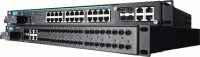 Moxa, a global provider of industrial automation solutions, is proud to announce that its new PowerTrans PT-7528 series, the industry’s first Ethernet switches designed to fulfill IEC 61850-90-4 requirements and equipped with built-in MMS servers, is now available.
 Rockwell Automation has announced that it has agreed to purchase Jacobs Automation, the leader in intelligent track motion control technology. Jacobs Automation provides a motion control solution called the iTRAK System. This technology improves performance across a wide range of packaging, material handling, and other applications for the global machine builder market.
 Rotork Schischek ExMax explosionproof actuators have been selected to assist the production of biogas for district heating systems in the German city of Munich. Biogas is produced during the effluent treatment process at the city’s largest waste water plant Klaerwerk Gut Grosslappen, situated close to the world famous Munich Allianz Arena, home to Bayern Munich football club.
 Free Webinar: Manage Operational Risk With Confidence
 A new training laboratory at Russia’s Ufa State Petroleum Technological University (UGNTU) features the latest Honeywell equipment and computer modeling software to help train future oil and gas engineers. The equipment, provided by a grant from Honeywell, will be used for training process engineering students and students majoring in process automation and control, allowing them to computer model process facilities in the oil refining and petrochemical industries.
 The Endress+Hauser Group has strengthened its position in the South American market. The Swiss specialist for measurement engineering has invested over eight million euros in a new production facility for flow, level and pressure measuring instruments in Brazil. The plant in Itatiba, around 100 kilometers north of São Paulo, has now been inaugurated.
 As part of its VPS* initiative, Yokogawa Electric Corporation announces that it will release an upgraded VPSRemote™ service solution on November 22. VPSRemote is a solution for the remote monitoring and general and preventive maintenance of systems. The upgraded VPSRemote now allows users to link their plants around the world and provide operation support and engineering services from specified locations on the network. The upgraded VPSRemote solution can now be used with information systems as well as control systems.