
 Honeywell has recently announced that it has been selected by Preem AB to modernize one of Europe’s largest refineries – Preemraf Lysekil – with Honeywell’s Enhanced High Performance Process Manager (EHPM) industrial process controllers.
The project should significantly extend the life of the existing control system at the refinery, located in southern Sweden. Preem AB, the country’s largest oil producer, will use the enhanced high performance process manager to as much as triple the capacity of the refinery’s existing controllers.
Preem AB has an annual refining capacity of more than 18 million metric tons, accounting for 75 percent of refining capacity in Sweden and about one-third of the entire Nordic region. Preem AB is the largest supplier of ultra-low-sulfur diesel fuel in Sweden, with a sulfur content of less than 5 ppm (parts per million), significantly lower than the Euro 4 requirement of 50 ppm.
“Honeywell’s Enhanced High Performance Process Manager enables Preem to modernize their refinery and increase through-put while maximizing legacy investments and intellectual property,” said John Rudolph, vice president for Honeywell Process Solutions’ Lifecycle Solutions and Services business.
The upgrade will be completed during planned maintenance at the refinery and will not require any additional downtime. It is scheduled to be completed before the end of the year.
“This investment builds on Lysekil’s position as the region’s leading refinery and will deliver real benefits for decades,” said Lars Andersson, automation manager at Preem AB. “It also means we can maintain and improve on a safe, efficient operation, without the disruption and cost of ripping out and replacing the entire control system.”
With support for peer-to-peer communication planned for the future, EHPM will allow Preem to incorporate other technologies from Honeywell, to provide an integrated solution that can include continuous and batch processing controls such as Experion C300, safer operations with Safety Manager, and Honeywell’s fault tolerant ethernet FTE technology, that offers more robust, faster network diagnostics and improved security.
Nike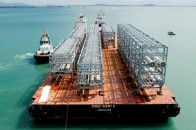 ABB, the leading power and automation technology group, has signed a long-term service agreement (LTSA) with QGC, a wholly owned subsidiary of BG Group, to provide planned and unplanned maintenance for the up- and mid-stream facilities at Queensland Curtis Liquefied Natural Gas (QCLNG). The project, located in Queensland, Australia, is the world's first to convert gas from coal-seam into liquefied natural gas.
 The Fieldbus Foundation has recently announced the first public release of FDI Cooperation, LLC's Field Device Integration (FDI) specification and a demo of the FDI developer toolkits, both of which will make it possible for automation suppliers to prepare for developing products and host systems compatible with FDI. The Fieldbus Foundation is one of the founding members of FDI Cooperation, LLC.
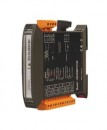 Remote I/O, or distributed I/O, offers several advantages over the traditional local I/O found on a Programmable Logic Controller (PLC). First, it allows you to locate the I/O modules close to the process that is being monitored or controlled. This greatly improves noise immunity, as the weak sensor signals are converted to digital signals before being transmitted long distances through a noisy plant environment. OMEGA universal remote I/O modules use a simple 2-wire RS485 link using MODBUS RTU/ASCII protocol, which is supported by most programmable logic controllers. A second advantage is that remote I/O greatly reduces the wiring at the main control panel, saving time and money when repairs and upgrades are necessary. Adding additional sensors and control signals is as easy as connecting to the already installed RS485 link and modifying the PLC program to utilize the new I/O. In addition, remote I/O allows you to expand your process control system beyond the local I/O capabilities of your PLC. You can add thermocouple, RTD, pressure, and flow sensors to a PLC that doesn’t support these types of inputs. With remote I/O, your process application is no longer dependent on your controller choice.
 Lloyd`s Register EMEA has certified HIMA HIMax, HIQuad und Planar4 safety system families for use in marine and offshore applications in the relevant environment categories ENV1, ENV2 and ENV3. HIMA HIMatrix modules received Lloyd’s Register certification in 2006, which was extended in 2011.
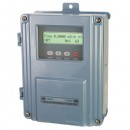 FDT-21W ultrasonic flowmeter is designed to measure the fluid velocity of liquid in a full/closed pipe. It is a measurement system which is both easy to install and use. The FDT-21W operates according to the difference in the transit time of flight measured, and determines the flow velocity by measuring the travel time of a pulse from one transducer to the next. Flow in the same direction takes less time to travel to the second transducer than does flow in the opposite direction. Electroacoustic transducers receive and emit brief ultrasonic pulses through the liquid of the pipe. Transducers are vertically placed at both sides of the measured pipe. Sensors are placed on the pipe and fastened by means of a clamp. The display will quickly show the flow velocity. The FDT-21W can be used for metallic, plastic and rubber tubes.
 Foster Wheeler has announced that a subsidiary of its Global Engineering and Construction Group has been awarded a contract by Axion Energy Argentina S.A. (“Axion”), a subsidiary of Bridas Corporation, to provide engineering and procurement services for a new delayed coking unit based on Foster Wheeler’s SYDEC(SM) delayed coking technology, to be installed at the Campana Refinery in Buenos Aires Province, Argentina.
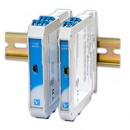 Acromag expands their line of versatile USB-configured signal conditioning transmitters to include RTD/resistance and potentiometer/thermistor input signals.
 Tyco has announced the acquisition of Westfire, Inc., a leader in special-applications fire protection services with operations in the United States, Chile and Peru. Westfire provides critical special-hazard suppression and detection applications in mining, telecommunications and other vertical markets. Their full range of fire protection services includes hazard analysis, as well as system design, installation, maintenance and testing combined with customized system documentation.