
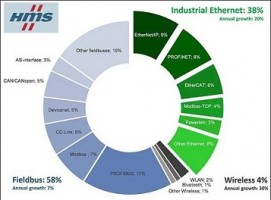
 Industrial Ethernet is growing faster than before and now accounts for 38% of the market. EtherNet/IP is in first place within industrial Ethernet globally, followed by PROFINET. However, classic fieldbuses are still dominating the fragmented world of industrial networks with 58% and PROFIBUS is still the most widely used industrial network. Furthermore, the Internet of Things is driving wireless technologies which are now on the chart for the first time.
HMS Industrial Networks now presents their annual analysis of the industrial network market. As an independent supplier of products and services for industrial communication and the Internet of Things, HMS has a substantial insight into the industrial network market. Here are some of the trends they see within industrial communication in 2016.
Fieldbus is still growing:
Looking at new installed nodes within factory automation globally, fieldbuses are still the most widely used type of networks with 58% of the market. Fieldbuses are still growing by approximately 7% per year as users ask for simplicity, tradition and reliability.
The dominant fieldbus is PROFIBUS (17% of the total world market including industrial Ethernet) followed by Modbus (7%), and CC-Link (6%).
Industrial Ethernet is growing faster than before:
According to HMS, industrial Ethernet is growing faster than previous years and taking more market shares. At a growth rate of 20%, Ethernet now makes up for 38% of the global market compared to 34% last year. EtherNet/IP is the number one Ethernet network with 9% followed by PROFINET (8%). Runners-up are EtherCAT, Modbus-TCP and Ethernet POWERLINK.
“We see evidence of an accelerated transition towards industrial Ethernet when it comes to new installed nodes,” says Anders Hansson, Marketing Director at HMS. “However, industrial automation is a conservative market and it will take time before industrial Ethernet outgrows fieldbuses.”
Wireless is coming:
For the first time, wireless technologies are on the chart with 4% of the worldwide industrial network market. WLAN is most popular, followed by Bluetooth.
“We see the Internet of Things as a big driver for wireless technologies,” says Anders Hansson. “Wireless opens up for new automation architectures and is increasingly being considered for machine connectivity and control, including Bring Your Own Device (BYOD) solutions via tablets or smartphones.”
Regional facts:
In Europe and the Middle East, PROFIBUS is the leading network while PROFINET has the fastest growth rate. Runners up are EtherCAT, Modbus-TCP and POWERLINK.
The US market is dominated by the CIP networks where EtherNet/IP is overtaking DeviceNet in terms of market shares.
In Asia, no network stands out as truly market-leading – PROFIBUS, PROFINET, Ethernet/IP, Modbus and CC-Link are widely used. EtherCAT continues to establish itself as a significant network, and there are early signs of CC-Link IE Field being adopted.
More and more devices are getting connected:
“The presented figures represent our consolidated view, taking into account insights from colleagues in the industry, our own sales statistics and overall perception of the market,” says Anders Hansson.
“It is interesting to see that industrial Ethernet is now growing faster and that wireless technologies are gaining foothold. What is completely clear, however, is that the network market remains fragmented as customers continue to ask for connectivity to fieldbus, industrial Ethernet as well as wireless networks. All in all, industrial devices are getting increasingly connected, boosted by trends such as Industrial Internet of Things and Industry 4.0. With our long-term motto ‘Connecting Devices,’ HMS is well-suited to grow with these trends.”
Courtsey HMS - Industrial Networks
 Rockwell Automation has announced that it has agreed to purchase MagneMotion, a leading manufacturer of intelligent conveying systems. MagneMotion systems are used across a broad range of industrial applications including automotive and general assembly, packaging and material handling. This acquisition will complement Rockwell Automation’s iTRAK to create the broadest portfolio of independent cart solutions in this emerging technology area.
 Honeywell has launched a new app providing plant managers immediate notifications as well as real-time plant performance data and analytics direct to their smartphones.
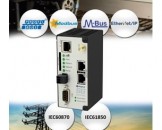 HMS Industrial Networks now introduces a new family of Industrial IoT gateways for Smart Grid applications. The Anybus SG-gateways enable communication between industrial applications and energy protocols.
 Moxa’s newly launched ThingsPro Suite is an integrated solution for distributed data acquisition and device management that can immensely simplify your Industrial IoT deployments. Built on an open Debian Linux platform, the ThingsPro Suite enables the integration of Modbus communications and device management, data acquisition and processing, and wireless networking, in a few simple steps.
 Oman Liquefied Natural Gas LLC (OLNG) is a limited liability joint venture established by a royal decree and operated under the laws of the Sultanate of Oman. It produces and sells liquefied natural gas (LNG) and byproduct natural gas liquids (NGLs).
 The implementation of an automatic dosing of the flocculants allows the customer to respect (24h a day, 365 days a year) the limit for phosphate in the outlet and save a lot of money: resulting in less chemicals and sludge production.
 Yokogawa Electric Corporation announces the establishment of Industrial Knowledge, a new business unit that will play a key role in accelerating expansion of Yokogawa's business in asset intensive industries through the provision of cloud-based advanced solutions. Expansion of the advanced solution business, whose goal is to maximize performance for our customers through the attainment of operational excellence, is one of the important strategies set out in Yokogawa's Transformation 2017 mid-term business plan.
 IEC-61850 is the specific standard for smart substations and defines the Ethernet protocol to be used for data communication and defines how devices in the substation communicate with each other. IEC-61850-3 devices need to meet electromagnetic Interference (EMI), temperature, and shock/vibration resistance requirements.