
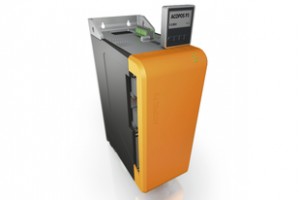
 The new 2-axis modules from B&R's ACOPOS P3 series feed braking energy back into the mains. This function significantly improves the overall effectiveness of a machine. With just 500 watts of regenerative braking power, the function pays for itself in only a year.
A prime candidate for this function are machine tools, whose headstock spindle drives generate large amounts of braking energy that would otherwise go unused. The function is also well suited for conveyor systems that move heavy loads vertically. Without power regeneration, not only would the braking energy go to waste, but the resulting heat would require additional cooling and consume even more power.
Regenerative braking is implemented particularly efficiently in the new 2-axis modules from the ACOPOS P3 series. One of the axes is configured as the feedback path to return excess power to the mains.
Additional functions with ACOPOSmulti
Like the new ACOPOS P3, the active power supply modules from the ACOPOSmulti series also support regenerative braking. These models also offer other helpful functions such as stabilization of the DC bus voltage and compensation of the reactive power.
 Schneider Electric Software, a global leader in industrial software and part of Schneider Electric, the global specialist in energy management and automation, announces that customer Fujirebio Diagnostics, Inc. was placed in the Top 10 of the 2015 Workflow Management Coalition (WfMC) Global Awards for Excellence in Business Process Management (BPM).
 exida, a global supplier of functional safety products, services and certifications is pleased to announce a business partnership with Phoenix Contact.
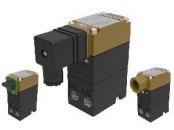 Rotork Fairchild has launched a new range of compact low pressure I/P (electro-pneumatic) transducers for instrument, analytical and scientific control applications.
 Todd Stauffer, exida Director of Alarm Management Services is the recipient of the ISA Standards and Practices Department Award. This award is in recognition of outstanding contributions as working group chair in the development of ISA-TR 18.2.3, Basic Alarm Design, and for pioneering work in development of the technical reports for the first standard on alarm management.
 The Instrumentation and Automation Symposium for the Process Industries, now in its 71st year, continues to educate professionals and students in the instrumentation industry. At the symposium, practical technical papers as well as vendor exhibits are presented with a focus on education.
 Information technology (IT) has permeated manufacturing infrastructure and operations, producing The Connected Enterprise and triggering questions about responsibility for plant-based networks and assets. IT and operations technology (OT) professionals are facing convergence in their duties and the skill set required to succeed. Rockwell Automation and Sunset Learning Institute (SLI) are teaming up to improve and increase access to continuing education and certifications surrounding the Industrial Internet of Things (IoT).
 The technology company The Linde Group has been selected by Gazprom, Gazprom Pererabotka Blagoveshchensk and its general contractor NIPIgas as the licenser for cryogenic gas separation technology at the Amur Gas Processing Plant (Amur GPP), located in the far east of Russia. Linde will engineer and supply units for ethane and natural gas liquids (NGL) extraction and nitrogen rejection, as well as for helium purification, liquefaction and storage.
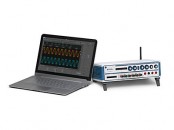 NI (Nasdaq: NATI), the provider of platform-based systems that enable engineers and scientists to solve the world’s greatest engineering challenges, announced today a new, high-performance model of VirtualBench. The software-based VirtualBench all-in-one instrument combines a mixed-signal oscilloscope, function generator, digital multimeter, programmable DC power supply and digital I/O. With 350 MHz of bandwidth, four analog channels and Ethernet connectivity, the new version of VirtualBench offers increased functionality for engineers characterizing and debugging new designs or automated test systems.