
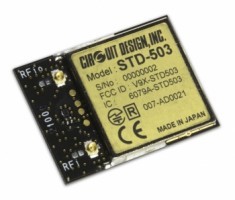
 Saelig Company, Inc. (www.saelig.com) has introduced the STD-503, a 2.4 GHz radio transceiver module, designed to facilitate the simple embedding of wireless capabilities in industrial remote control equipment. Suitable for worldwide implementation, this compact radio transceiver module was specifically developed for industrial applications that must have stable and reliable communication for up to 300 yards with battery operation.
To ensure highly reliable radio communication in the congested 2.4 GHz ISM band, the module uses highly noise-resistant direct-sequence spread spectrum (DSSS) modulation, as well as a true diversity receiver design that employs two antennas, each with its own receiving circuit, thus preventing signal dropout due to multi-path fading. The use of two antennas facing different directions to insure transmission reliability is a feature not available in most lower cost receivers.
The data interface of the STD-503 is transparent, enabling users with proprietary protocols to use them without modification. But the interface also offers a high degree of freedom, enabling continuous transmission of Low or High signals without restriction.
At only 1.6" x 1.15" x 0.22", the STD-503 is 50% smaller than its predecessor the STD-502-R. Additionally, the STD-503 now allows channel switching according to a preset channel plan via pin selection (up to 20 frequency channels can be saved in the plan). It uses a custom ASIC with DSSS modulation and true diversity processing in order to guarantee the long-term supply availability of key radio components. Transmitting data at up to 19.2kps, the low power operation of 10mW is achieved using a 3.3V 65mA supply. The STD-503 is already certified to FCC Part 15.247 for USA, EN 300 440 for Europe, ARIB STD-T66 for Japan, making it ready to use for the global market. Capable of operating from -20 to +65degC, the STD-503 will find application in the reliable remote control of industrial equipment, industrial telemetry, and monitoring systems.
Nike
 Yokogawa Electric Corporation announces that it will release an enhanced version of the STARDOM™ network-based control system on June 3. The new STARDOM version features enhancements that reduce communication costs and ensure highly reliable monitoring and control. These enhancements meet a variety of needs in upstream oil and gas development and production, which Yokogawa is targeting based on its Transformation 2017 mid-term business plan.
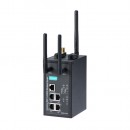 Moxa is pleased to release the WDR-3124A, the company’s first wireless router that combines both WLAN and WWAN connectivity to ensure that your wireless devices are connected anywhere, anytime. The WDR-3124A’s innovative auto-switch failover function enables automatic switchovers between 802.11n and HSPA standards, ensuring wireless availability for your mission-critical systems.
 The expansion of the Industrial Internet of Things (IoT) and convergence of operations technology (OT) and information technology (IT) systems into The Connected Enterprise raises questions of who within industrial organizations should design and oversee unified network infrastructures. Rockwell Automation, in collaboration with its Strategic Alliance partner Cisco, is helping address this workforce challenge with the new training and certification offerings.
 KBR Inc. has announced today it has been awarded a near-shore floating LNG Front End Engineering Design (FEED) contract by Lloyds Energy Ltd. Under this contract, KBR will provide integrated topsides and hull engineering design services for a nominal 2.5 million TPA floating natural gas liquefaction plant (FLNG). Start-up of the project facilities is expected to take place in 2019.
 Yokogawa Electric Corporation announces the release on this date of the SensTation pH/ORP measurement system, a scalable and integrated solution that combines the unique capabilities of the SENCOM pH/ORP sensors and the SMARTDAC+ data acquisition and control system. This solution eliminates the need for a pH/ORP transmitter and allows users the choice of any of the paperless recorders in the SMARTDAC+ series, each of which can connect to up to 16 sensors. In addition to supporting a wide range of analytical and data control applications, this solution improves maintenance efficiency.
 Jacobs Engineering Group Inc. has announced that it has been awarded an engineering, procurement and construction management (EPCM) contract from Celanese Corporation for the construction of a vinyl acetate ethylene (VAE) emulsions production plant at Jurong Island, Singapore.
 Dwyer MBLT Miniature Submersible Level Transmitter is only 0.63" in diameter making it ideal for level monitoring in well and borehole applications. Constructed for years of trouble free service, the MBLT has a welded 316 SS body and 316 SS nose cap. Body top is also 316 SS and tapered to prevent damage or snares when pulling the unit out of the installation. Featured in the MBLT is a precision ±0.10% or ±0.25% of full scale accuracy output, better than BFSL or BSL rated outputs used by most competitors. Lightning and surge protection (not guaranteed or covered by standard warranty) is included standard to stand up in harsh applications. MBLT comes with a choice of polyether polyurethane or ETFE cable materials and all are vented for barometric pressure compensation. Vent is covered with a maintenance-free filter preventing particulate or water droplets from entering the transmitter.