
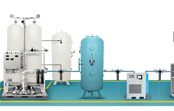
 The medical gases department of MTE Verifylab provides air and medical oxygen to hospitals and clinics. Their plants at these medical facilities are relied on to provide a steady and uninterrupted supply of medical oxygen. Recently, MTE Verifylab completed a project for 10 clinics operated by one of Columbia’s largest healthcare providers. Their innovative solution called for centralization of the data acquisition and the quality reporting functions at a telemetry facility in Bogatá, thereby eliminating the need for technical staff at each location. This reduced monthly operating costs 25%.
To ensure an uninterrupted 24/7 supply of medical oxygen, MTE Verifylab employed a two-level contingency system in addition to their main PSA generation supply system: cryogenic tanks and oxygen manifolds. As the operating costs for this PSA technology are up to 55% lower compared to these other contingency systems, a main goal is to maximize its use without incurring any risk of a cutoff in the supply of medical oxygen to the patients at these facilities. This requires real-time monitoring of every variable and automated switching between supply systems.
Please click Case Study by Yokogawa to download
Nike Benassi Slide
 Zurich, Switzerland, March 8, 2012 – ABB, the leading power and automation technology group, has won a $60 million contract from Shell Gas Iraq B.V. to build a new power plant in southern Iraq.
 SNC-Lavalin (TSX: SNC) will provide project management, engineering, procurement and construction management (EPCM) services for Vale’s $2-billion Clean AER (Atmospheric Emissions Reduction) Project in Sudbury, Ontario.
 IRVING, Texas--(BUSINESS WIRE) Fluor Corporation (NYSE: FLR) announced today that it was awarded an engineering, procurement and construction management (EPCM) contract by Joule to design and build a renewable fuel production facility in New Mexico. Fluor booked the undisclosed contract value in the fourth quarter of 2011.
 National Instruments has announced four new NI Single-Board RIO board-level embedded devices featuring a real-time processor, Spartan-6 field-programmable gate array (FPGA), analog and digital I/O and more built-in peripherals for custom embedded control and monitoring applications. The new devices provide engineers with off-the-shelf FPGA and real-time processor technology through NI LabVIEW while maintaining the custom I/O often required for high-volume deployments through the option of a RIO Mezzanine Card connector. The connector provides direct access to FPGA digital input/output (DIO) lines and certain processor-specific functions for mating custom daughter cards. NI Single-Board RIO alleviates the effort of designing an entire system from scratch so designers can focus on the custom parts of their applications, such as the I/O.
 The prospect of adding wireless devices to the process automation architecture is a compelling one from the perspective of tangible business benefits and incremental operational improvements. Availability of robust industrial wireless network protocols, such as WirelessHART and ISA100.11a, for use with IEEE standard technology makes the prospect even more attractive relative to past proprietary, often standalone wireless implementations. This potential is somewhat offset, however, by competition between these standards that leads customers to fear that wireless is emerging as the next platform for the automation fieldbus wars.